6 October 2010

Autumn galls

Brede High Woods is entering its autumn phase now.  After the recent rains fungi are abundant and many of the trees are starting to turn colour.

One new record was of the ground ivy gall (Liposthenus latreillei or glechomae) caused by a small cynipid wasp.  Round galls like his are mostly found on trees and shrubs and it is quite a surprise to see them on such a low growing plant.

20101006 SV BHW 035

Maybe their being close to the ground accounts for the fact that they are called cat's testicles in Hungary.

22 July 2010

Walk round Sedlescombe Heath

The areas cleared last year on what we call 'Sedlescombe Heath' are showing signs of benefit from the extensive conservation work.

In places dwarf gorse and heather seedlings are growing well and there are now two sites for dodder (Cuscuta epithymum) which we thought we might have lost.

20100719 BHW 029

The strange thing is that this parasitic plant, when in flower, looks much like heather (Calluna vulgaris), its host in Brede High Woods, but it comes out a few weeks before the heather so can be easily spotted.
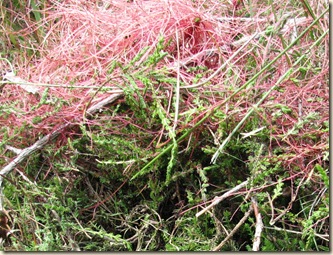
20100616 BHW dodder & heather 003b

Before flowering it looks very different (see above) as a mass of tangled, red threads with no chlorophyll.

Dodder is a declining species that was formerly much more abundant on the unimproved heathlands in Sussex and elsewhere.

Another plant that is taking advantage of the new clearances is heath groundsel (Senecio sylvaticus) which seems almost confined, though in considerable quantity, in the area just south of the orchard where the Norway spruce was cleared. 

20100719 BHW 016

I have a feeling the wind blown seeds must have been caught by the pine branches and have lain dormant until there was sufficient light to trigger their germination.  The plants seem to be very ephemeral and I suspect they will decline and disappear in this area within a year or two as other species develop.

Butterflies are also benefiting from the wider rides and longer woodland edges.  The only one I photographed was this very worn female ringlet (Aphantopus hyperantus), a species that is actually expanding its British range.

20100719 BHW 025

Also on the wing were meadow browns, gatekeepers, small coppers, red admirals, large and small whites, large and small skippers and several silver-washed fritillaries, a splendid butterfly that seems to be having a good year.

There was also a red and black burnet moth zooming across Holman Wood Field.  Probably a six-spot and good to see as this seems to be another attractive species that has declined massively in our area over the last few years.

16 June 2010

Corn spurrey

There are quite a few plants of corn spurrey (Spergula arvensis) currently in flower on the area south of the orchard that was cleared of dense Norway spruce last summer.

20100616 BHW fixed point etc 013

The plant is an ancient introduction, a so-called archaeophyte.  It was once widespread on arable and disturbed ground but is now in rapid decline due to agricultural improvement.  Some of its seeds, however, are thought to remain viable for a very long time and the plants in the former spruce plantation have almost certainly come from a pre-conifer seed bank.

It requires acid, sandy soil and does not grow on chalk or limestone.  It was once a problem weed and is a sign of poor ground.  In Shetland where it is called 'meidi' any quantity of the plant was regarded as a sign that the ground needed more manure.

As well as meidi there are many other country names, a sure sign that the plant was important from the way it indicated soil deficiencies.  These names include beggar-weed, bottle brush, cowquake, dother, farmer’s ruin, franke, granyagh, lousy grass, makebeg, make-beggar, mountain flax, pick pocket, pickpurse, poverty weed, sand-grass, sandweed, spurry, yarr, yarrel, yawr and yur.

The leaves of the plant are very distinctive being arranged in whorls and rather widely spaced along the stems.  They are also quite sticky from glandular hairs.

20100616 BHW corn spurrey leaves 019

14 June 2010

Celery-leaved buttercup

Today I found a small plant of celery-leaved buttercup, Ranunculus sceleratus, in an open area to the south east of Austford at TQ789204 beside the path running south from the footpath crossroads.

20100614 BHW fixed point & Stanmer 067

This seems to be the first record for Brede High Woods.

The plant is filled with an acrid juice that raises blisters better, it seems, than any other buttercup.

The Reverend John Lightfoot in his Flora Scotica (1777) described it as having a "most acrimonious quality" adding that "Strolling beggars have been known sometimes purposely to make sores with it, in order the more readily to move compassion."

Haven't seen many strolling beggars in the woods lately.

6 June 2010

Cloaked Pug moth (Eupithecia abietaria)

A couple of days ago I spotted this rather large pug moth on a conifer trunk in the Austford area of Brede High Wood.

20100604 BHW pug moth cpt 3b 015

It looked to me like a cloaked pug (Eupithecia abietaria) and Colin Pratt, the Sussex lepidoptera recorder, has confirmed, subject to the size of the moth, that this determination is correct.

One was caught in 1986 about five miles from this location, otherwise this is only the second record for East Sussex in the past 100 years.

Apart from some scattered records, this species seemed to die out in Britain in the early 20th century, but has since been rediscovered in some places, maybe as a result of immigration from mainland Europe.

The caterpillars feed on the cones of Norway and Sitka spruce as well as noble fir.  There were several of the first two trees in the area where the moth was found so, hopefully, it is breeding there.

5 June 2010

Giant ichneumon egg laying

Today I was lucky enough to spot a female giant ichneumon, Rhyssa persuasoria, laying her egg on some hapless grub deep inside a pine log near Austford in Brede High Woods.

20100605 BHW Rhyssa persuasoria 018c

It is one of natures wonders how the insect manages to drill her ovipositor down through often quite hard wood to locate the host larva with great accuracy.  You can see in the picture how she has to curve her ovipositor up, then round in a circle to get it pointing directly downwards.

Having caught her in the act, it was not particularly difficult to photograph, but after a few shots she spotted me, gave me a glare and flew off at high speed.

I often wonder about the evolutionary history of creatures like this - is this really an easier way to survive than the innumerable alternatives, like eating mud, that other insects have evolved?

20100604 BHW baseline Cpt 4b central mud towerlets 045

22 May 2010

A beetle for Biodiversity Day 2010

Today, 22 May, is the International Day of Biodiversity.  In the spirit of such an event a group of us, under the auspices of Butterfly Conservation, went on a caterpillar foray in Brede High Woods.

The weather was glorious, but the adult butterflies rather few.  Despite enlightened management species like the grizzled skipper, the green hairstreak or the pearl-bordered fritillary no longer seem to be present.

However, there was a compensation.  In a waist high grove of aspen suckers we found several groups of the larvae of the ladybird-like leaf beetle Gonioctena decemnotata, a Nationally Notable (B) species normally found on aspen.

20100522 BHW Gonioctena decemnotata 003

The remarkable thing was that each group of the black leaf-munching larvae was guarded nearby by an adult, presumably mother.

Such solicitousness for offspring is rare in the insect world and I would imagine a small vegetarian beetle would have minimal ability to drive off a hungry predator.  Does the red colour, I wonder, act as a sort of stop light and say "keep your distance."

The only other East Sussex record for this species I can find is from Bixley Wood a few miles from the Brede High Wood site.

20100522 BHW Gonioctena decemnotata 004