30 October 2008

Burdock leaf mining fly

Along the path by the transmission lines at about TQ 8047 2040, there is a plant of greater burdock (Arctium majus) with its leaves heavily mined by larvae of the agromyzid fly Phytomyza lappae.

20081027 BHW Phytomyza lappae 011

The plant is not common in Brede High Woods but the seeds in their sticky burrs no doubt get stuck to the pelts of dogs and human nether garments from time to time and drop off by footpaths.

It is rather wonderful that the tiny black fly that these larvae will turn into is able to locate the greater burdock plants so efficiently, though who knows how many die searching.

29 October 2008

A sycamore leaf spot

The microfungus, a hyphomycete, that causes the spots on the sycamore leaf below is Cristulariella depraedens. 
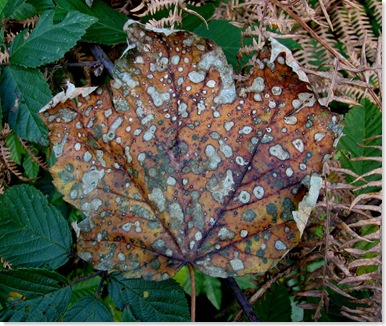
20081027 Wbx & Brede High Wood 032

There are plenty of different species of microfungi to be seen in the woods all round the year and, while many are difficult to identify, those on plants can be relatively easy with the help of Microfungi on Land Plants by Ellis & Ellis (Richmond Publishing, 1997).

Many of these rusts, mildews and leaf spots are specific to a particular kind of plant and you can just run through those listed in the book as occurring on leaves (or whatever) and see which fits best.  There are some helpful line drawings in the back of the book for those with microscopes, but these days there are often many photographs on the web.

Very often one has the satisfaction of being able to claim a new species record for the Sussex Biodiversity Records Centre - this is the first county record of our friend Cristulariella depraedens, for example, though I have no doubt that it is quite common, but not so common as the tar spot fungus Rhytisma acerinum that disfigures sycamore leaves with black patches almost everywhere outside polluted areas (see below):
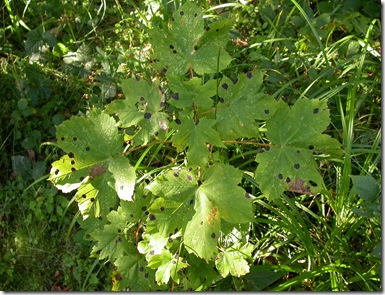
Tar spot fungus on sycamore leaves BHW

The tar spot fungus cannot cope with air pollution.

28 October 2008

High-cut sweet chestnut

Just to the north of the public footpath at TQ 8047 2022 there is a coppiced chestnut (Castanea sativa) with a high-cut stool whereas all the others in the area are low-cut almost to ground level. Both are shown in this picture:

20081027 BHW Cpt 7a High-cut chestnut stool

George Peterken (1981) in his Woodland Conservation and Management cites many coppices in Britain where there is a haphazard and inexplicable mixture of low-cut and high-cut stools, though generally low-cut stools are reckoned to produce better poles.

He does say, however, that "some high-cut stools marked compartment boundaries in woods that were otherwise cut low." The example in the picture above is close enough to the footpath, which here follows the old track across the pond bay, for this to be a feasible explanation. It would be quite difficult, with a landmark like this, to lose the corner of the coupe (blocks of coppice are variously known as 'cants' or 'coupes' and by other local terms as well as 'compartments' and 'subcompartments'). The lower part of the high-cut stool (the trunk) is technically known as a 'bolling' (to rhyme with 'rolling').

22 October 2008

Chestnut coppice wildlife

Chestnut coppice is often rather poor in terms of wildlife.  After all, the tree is not a native and has rather few creatures that feed on it and the regimented alternation between open ground and densely shaded cover in the coppiced areas may give a periodic boost to spring flowers on the ground, but is not necessarily of as much value to wildlife as other kinds of woodland management.

20081012 Brede High Wood 002

In Brede High Woods there is a suite of fungi that occurs sparingly in the sweet chestnut areas.  The oak mazegill bracket fungus (Daedalea quercina) below is growing on chestnut, but prefers oak.

20081020 BHW 020

The fungus causes heart rot in timber, is very tough and totally inedible.  Among its few redeeming feature is that it was once used in North America as tinder.  The ForestHarvest web site also claims it can be used for making paper (so, maybe, can any fibrous vegetable substance) and, more cryptically "used to provide craft materials for personal use."

21 October 2008

Plant of the moment - broad buckler-fern

The broad buckler-fern (Dryopteris dilatata) is one of the commonest fern species in Brede High Woods. The stand below is particularly vigorous and grows on top of an old, mossy pile of logs just inside the Lone Barn Gate at OS map reference TQ 8069 1947.

20081019 BHW Dryopteris dilatata 1

The roots of this plant contain filicin, apparently a substance that helps to get rid of tapeworms, and both roots and fronds have been used in the treatment of dandruff.

However, the plant is mildly toxic so the remedy might be worse than the affliction - definitely not one to try at home.

This toxicity is, perhaps, reflected in the fact that deer seem to leave it alone as they do many ferns.

Talking of which the local deer are rutting at the moment and the air frequently reverberates with the growl of a lusty stag. One friend suggested they might being trying to compete with the buzz of chain saws where some alien rhododendron is being cleared.

20 October 2008

Porcelain fungus (Oudemansiella mucida)

On a fallen beech tree in Greenden Wood towards the west of the Brede High Woods complex, while out walking with friends, we came across a fine display of the porcelain fungus growing from the dead sections of wood on a windthrown, but still living, beech tree.

20081020 BHW Oudemansiella mucida 016

Although very thin and delicate, the species is edible if the sticky slime that covers the cap is washed off.  A French book on fungi (Le grand livre des champignons) describes is as a very mediocre food item and it is almost certainly not worth the bother both on quality and quantity grounds.  Much better just to enjoy the sight of it.

20081020 BHW Oudemansiella mucida 017a

19 October 2008

Autumn moves on

Despite forecasts of wind and rain, autumn moves on in fairly calm weather.  The hornbeam leaves seem very fine this year and the picture shows them carpeting the ground in an overstood coppice in Coneyburrow Wood.

20081019 BHW autumn leaves 015

Not far away there is an extensive patch of hemp agrimony (Eupatorium cannabinum) now with fluffy seed heads.  In summer the dusty pink flowers were alive with silver-washed fritillary and, sometimes, white admiral butterflies and they tend to look rather dull and dowdy at this end of the year.  However, they have their own autumnal beauty especially when caught by a slanting sunbeam.

20081019 BHW hemp agrimony seeds 042