27 February 2011

Snowdrops at last

Often in the early months of the year I have looked around the High Woods for snowdrops (Galanthus nivalis).

They are not a native species, but bulbs often get washed down streams, or occur on the sites of old gardens.

Today, however, I found a fine colony in subcompartment 6c on the eastern border of the woods where the long west/east ride reaches Reservoir Lane (formerly Powdermill Lane).  OS map reference TQ 81011 20283.

20110227 various 008

This isolated group contains many flowers indicating that it has been in situ for some time and is increasing having started, no doubt, as one or more bulbs in garden rubbish thrown over the fence.  It is on the heavy clay soil it likes so, maybe, the colony will spread as one of the alien species that normally attracts no hostility.

19 December 2010

Bleak midwinter pentagram

A small group of us walked through the snow mantled woods today not only in a blizzard but in a thunderstorm.

20101218 BHW & Ellie in snow 029

It was a bleak landscape appropriate for the close approach of Yule, Midwinter.

One of our group wanted to see the pentagram on the oak stump in Holman Wood.

Years ago people used to go there - maybe a group of modern pagans or wiccans - but there seem to have been no recent visits.

The stump was covered in snow and, as I brushed if off with my hand, it filled the grooves that had been cut to make the pentagram so that is stood out like a pattern on scraperboard.  The device wasn't immediately apparent but emerged, as though by magic, as the side of my had swept over the wood, packing snow into the grooves.

20101218 BHW pentagram in snow 032

The pentagram has been used in a huge variety of contexts, often religious, for at least 5000 years and its meaning varies according to whether the single point is at the top of the bottom.  In this case it is simply where I happened to be standing that put the point below.

The falling snow, the thunder, the stillness of the winter wood gave a luminous mystery to the cold emergence of this mystical symbol from the dark, dead stump.

As we stood the continually falling flakes of snow quickly obliterated the brief and icy revelation of this winter star.

19 November 2010

Coneyburrow autumn

On a lovely autumn day I walked around Coneyburrow Wood and some nearby areas.

There are still some interesting fungi about.  I found the always late wood blewits (Lepista nuda) in several places.

20101119 BHW Lepista nuda 033

20101119 BHW Lepista nuda 011

If well-cooked this is an edible species and I have had it from time to time but, I have to say, I am not too keen on it as food - I just enjoy its pale mauve embellishment of the November Woods.

There was also a rather fine turkey tail fungus (Trametes versicolor) growing on a stump, in this case without a very strongly marked pattern of differently coloured rings on the cap.

20101119 BHW Tramestes versicolor 017

On another stump I found a neat little puffball which I think is just a baby Lycoperdon perlatum a common woodland species.  All the pictures I have looked at show it as having a broad, short stalk below, but this may develop on the example I found, or be hidden in the moss.

20101119 BHW Lycoperdon

Another striking feature today was the lovely golden colour of the larch trees (Larix spp.) as they shed their needles for the winter.

20101119 BHW Larix in autumn  024

They are not a native British species and, generally speaking, I find them rather ugly with lots of dead, spiky branchlets.  They do, however, have this autumn moment and another in spring when the fresh green needles emerge.

20101119 BHW Larix in autumn  030

29 October 2010

Autumn delights

Brede High Woods is at its autumn best after last week's frosts, but the leaves will soon come down if there are strong winds and heavy rain in the offing.

20101029 BHW SV & more 028

If you walk from Reservoir Lane (TQ806193) at the transmission lines northwards along Goatham Lane there are many spindle trees in the hedge, some fruiting quite well.

20101029 BHW spindle berries

Opposite Lone Barn Farm there are several young elm trees with bright butter yellow autumn leaves.  Without flowers and fruit (and even with them) elms are difficult to identify, but these seem quite plainly to be the Dutch elm (Ulmus x hollandica).

20101029 BHW elms in autumn 23

I suspect both these and the spindles were originally planted to make a more varied hedge.

On one of the elm leaves I found the larval mine of the red elm pigmy moth (Stigmella lemniscella).

20101029 BHW elm leaf miner 1 

There are a few records of this from West Sussex but only two very old ones from East Sussex, though it has probably been overlooked.  It is widespread elsewhere in the southern part of Britain, though it is good to know it has found a place for itself in Brede High Woods.

Heading north from the Reservoir Lane corner along the transmission line path I found, between the second and third pylons a medium sized, multi-stemmed alder buckthorn (Frangula alnus) which I must have walked past hundreds of times without noticing.

20101029 BHW Alder buckthorn

It is the yellow leaves that make it stand out and autumn is a very good time to look for the less frequent trees and shrubs due to this added dimension.

6 October 2010

Autumn galls

Brede High Woods is entering its autumn phase now.  After the recent rains fungi are abundant and many of the trees are starting to turn colour.

One new record was of the ground ivy gall (Liposthenus latreillei or glechomae) caused by a small cynipid wasp.  Round galls like his are mostly found on trees and shrubs and it is quite a surprise to see them on such a low growing plant.

20101006 SV BHW 035

Maybe their being close to the ground accounts for the fact that they are called cat's testicles in Hungary.

22 July 2010

Walk round Sedlescombe Heath

The areas cleared last year on what we call 'Sedlescombe Heath' are showing signs of benefit from the extensive conservation work.

In places dwarf gorse and heather seedlings are growing well and there are now two sites for dodder (Cuscuta epithymum) which we thought we might have lost.

20100719 BHW 029

The strange thing is that this parasitic plant, when in flower, looks much like heather (Calluna vulgaris), its host in Brede High Woods, but it comes out a few weeks before the heather so can be easily spotted.
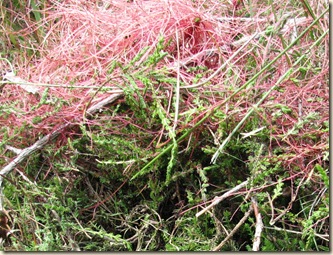
20100616 BHW dodder & heather 003b

Before flowering it looks very different (see above) as a mass of tangled, red threads with no chlorophyll.

Dodder is a declining species that was formerly much more abundant on the unimproved heathlands in Sussex and elsewhere.

Another plant that is taking advantage of the new clearances is heath groundsel (Senecio sylvaticus) which seems almost confined, though in considerable quantity, in the area just south of the orchard where the Norway spruce was cleared. 

20100719 BHW 016

I have a feeling the wind blown seeds must have been caught by the pine branches and have lain dormant until there was sufficient light to trigger their germination.  The plants seem to be very ephemeral and I suspect they will decline and disappear in this area within a year or two as other species develop.

Butterflies are also benefiting from the wider rides and longer woodland edges.  The only one I photographed was this very worn female ringlet (Aphantopus hyperantus), a species that is actually expanding its British range.

20100719 BHW 025

Also on the wing were meadow browns, gatekeepers, small coppers, red admirals, large and small whites, large and small skippers and several silver-washed fritillaries, a splendid butterfly that seems to be having a good year.

There was also a red and black burnet moth zooming across Holman Wood Field.  Probably a six-spot and good to see as this seems to be another attractive species that has declined massively in our area over the last few years.

16 June 2010

Corn spurrey

There are quite a few plants of corn spurrey (Spergula arvensis) currently in flower on the area south of the orchard that was cleared of dense Norway spruce last summer.

20100616 BHW fixed point etc 013

The plant is an ancient introduction, a so-called archaeophyte.  It was once widespread on arable and disturbed ground but is now in rapid decline due to agricultural improvement.  Some of its seeds, however, are thought to remain viable for a very long time and the plants in the former spruce plantation have almost certainly come from a pre-conifer seed bank.

It requires acid, sandy soil and does not grow on chalk or limestone.  It was once a problem weed and is a sign of poor ground.  In Shetland where it is called 'meidi' any quantity of the plant was regarded as a sign that the ground needed more manure.

As well as meidi there are many other country names, a sure sign that the plant was important from the way it indicated soil deficiencies.  These names include beggar-weed, bottle brush, cowquake, dother, farmer’s ruin, franke, granyagh, lousy grass, makebeg, make-beggar, mountain flax, pick pocket, pickpurse, poverty weed, sand-grass, sandweed, spurry, yarr, yarrel, yawr and yur.

The leaves of the plant are very distinctive being arranged in whorls and rather widely spaced along the stems.  They are also quite sticky from glandular hairs.

20100616 BHW corn spurrey leaves 019